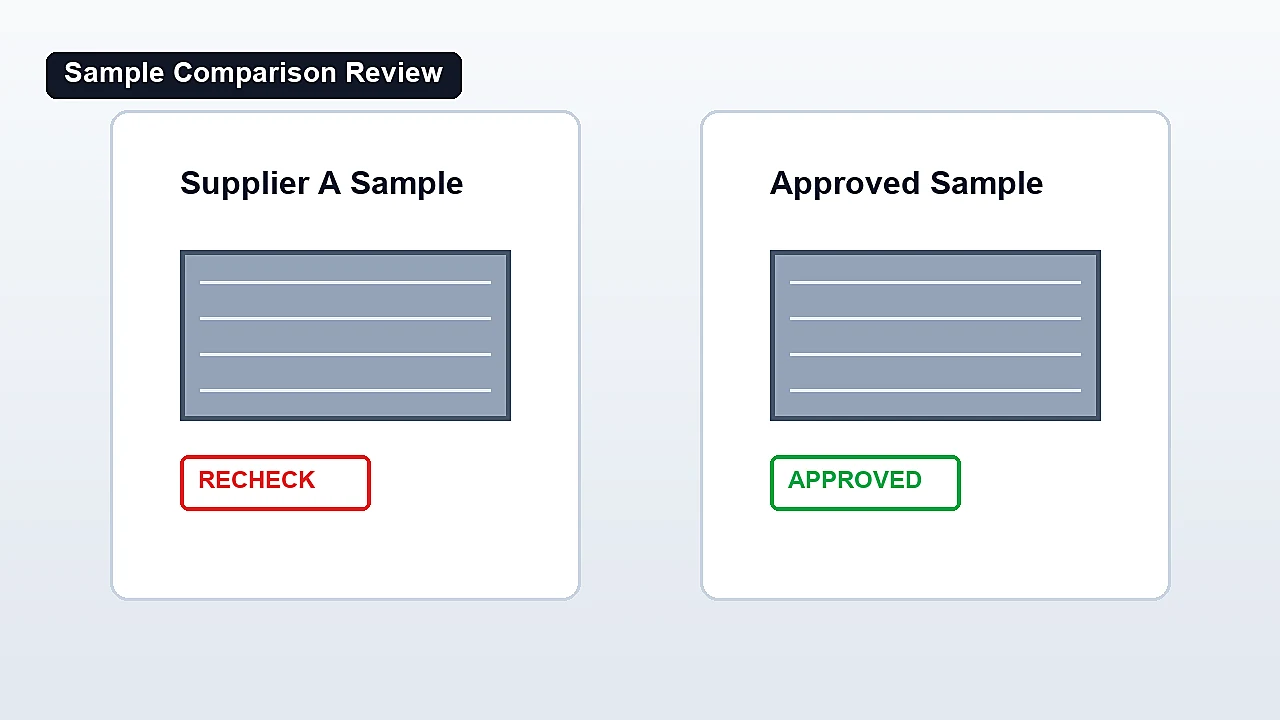
Most quality disputes are arguments about what was agreed, and they happen because the thing that was agreed was never physically preserved. A sealed golden sample turns an argument about intentions into a comparison between two objects.
Three kinds of sample, doing three different jobs
Stock sample. Something the factory already has on the shelf. Free or nearly free, arrives in days. It tells you the factory can make something in this category and roughly at what quality level. It tells you nothing about your product.
Custom or pre-production sample. Made to your specification, usually by hand or on prototype tooling. Costs money and takes one to three weeks. This is where specification errors surface — and finding them here rather than after a production run is the entire point.
Production sample. Pulled from the actual production line with the actual tooling, materials and process. This is the only sample that predicts what the order will look like. Hand-made samples are routinely better than mass production, which is why a beautiful custom sample followed by disappointing bulk goods is such a common story.
The gap between the second and third is where buyers get caught. Approving bulk production on the strength of a hand-finished sample means approving something that was never going to be reproducible.
The golden sample
Once a sample is approved, it becomes the reference against which the shipment is judged. To function as a reference it has to be handled properly:
- Two or three identical units, not one. One stays with the buyer, one with the factory, one with the inspection agency if a third party will inspect.
- Sealed and signed by both parties, with the date. A sealed sample cannot be quietly swapped later.
- Photographed from all sides before sealing, with the photographs attached to the order file.
- Accompanied by a written note of what it does and does not represent. This matters where the sample was made in a different colour or with substitute packaging.
That last point prevents the most common golden-sample dispute: the sample was approved for form and function but made in the wrong colour, and nobody wrote that down.
What to actually test
Handling the sample tells you less than you think. Worth doing before approval:
- Fit and assembly with whatever the product has to work with.
- The failure mode you care about. If the complaint history in your market is a broken hinge, work the hinge a few hundred times rather than admiring the finish.
- Dimensions against the drawing, measured rather than eyeballed. If a tolerance matters, state it as a number and check it.
- Material verification where the material claim carries cost. A stated grade of steel, resin or fabric can be tested, and the test is cheap relative to a container of the wrong material.
- Regulatory testing if the destination market requires it. Doing this at sample stage means a failure costs one sample rather than one shipment.
Who pays
The normal arrangement is that the buyer pays for custom samples and for the courier both ways. Two common variations:
Sample cost credited against the first order. Widely offered and worth asking for. It costs the factory nothing if the order happens and protects them if it does not.
Tooling cost separated from sample cost. Where a sample needs a mould or a die, that is tooling and should be quoted separately, because it raises ownership questions that a sample charge does not.
Sample charges are not usually where a supplier makes money, and a factory quoting an unusually high sample fee is often signalling that it does not want a small or exploratory order. That is useful information in itself.
The revision loop
Expect two or three rounds on a genuinely custom product. What keeps that loop from running away:
- Consolidate feedback. One list per round, not a stream of messages. Each round costs a week or more.
- Distinguish must-fix from nice-to-have explicitly, so the factory prioritises correctly.
- Photograph the defect rather than describing it. Descriptions translate badly; photographs do not.
- Re-state the unchanged requirements each round. Fixing one thing and breaking another is common, and a short checklist catches it.
When the sample is finally right, seal it before anything else happens. A golden sample created a week later from "one of the good ones" is not a golden sample.